Root planing continues to serve as a foundational procedure in the management of periodontitis. The objective is clear: eliminate calculus, disrupt biofilm, and create a smooth root surface that favors healing while minimizing unnecessary removal of healthy tooth structure. Success depends as much on instrument selection and technique as on clinical judgment.
Limitations of Conventional Approaches
Hand instruments remain essential, yet they can be time-intensive in deep or complex pockets and may leave residual deposits in hard-to-reach areas. Standard carbide burs, designed primarily for restorative preparation, often generate excessive vibration or aggressive cutting when used on root surfaces. This can increase the risk of surface roughness, over-instrumentation, or soft-tissue trauma.
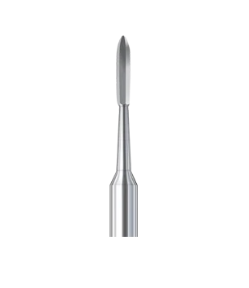
These challenges have driven the development of specialized periodontal rotary instruments engineered specifically for controlled debridement and planing. Specifically, legendary German bur manufacturer, Busch & Co. developed a collection Root Planing Burs for this very purpose.
Design Principles of Specialized Root Planing Burs
Modern periodontal burs from manufacturers such as Busch & Co. incorporate several targeted features:
- High-quality carbide or diamond construction that maintains cutting efficiency over repeated sterilizations and clinical use.
- Superior concentricity, which reduces vibration and improves tactile feedback. This allows clinicians to distinguish more readily between contaminated cementum and sound tooth structure.
- Geometry optimized for planing rather than aggressive cutting. Certain designs, including polygonal working ends without sharp edges (as seen in LongLife PERIO-PRO style instruments), promote a gentler planing action while still efficiently removing deposits.
- Varied lengths and diameters to improve access in deeper pockets or interproximal and furcation areas.
- Complementary diamond options in fine and extra-fine grits for progressive smoothing after initial debridement.
These characteristics support both non-surgical closed procedures and open-flap surgical approaches.
Clinical Integration
In practice, specialized root planing burs can be integrated into a sequenced protocol:
- Initial gross deposit removal with ultrasonic or hand instruments.
- Targeted rotary planing of residual calculus and roughened cementum using appropriate carbide designs at controlled speeds and light pressure.
- Final surface refinement with finer diamond instruments where indicated, particularly in early furcation involvement or after restorative cement cleanup.
- Thorough irrigation and evaluation of surface smoothness with explorers or magnification.
The reduced vibration and improved feedback often translate into more efficient chair time and greater operator confidence, especially in anatomically challenging sites.
Considerations for Clinical Outcomes
A smoother, properly debrided root surface is associated with reduced plaque retention and more favorable soft-tissue response. Instruments that minimize trauma while achieving thorough cleaning help preserve the biological potential for healing via long junctional epithelium or other repair mechanisms. Durability of the burs also contributes to consistency across multiple patients and reduced procedural interruptions.
As with any rotary instrument, proper handpiece maintenance, appropriate speed selection, light intermittent pressure, and adequate cooling remain essential for safety and performance.
Summary
Root planing outcomes improve when clinicians select instruments purpose-designed for periodontal applications rather than adapting general-purpose burs. Specialized German-engineered options that emphasize concentricity, controlled planing geometry, and long-lasting sharpness offer practical advantages in both efficiency and tissue respect. Incorporating these tools into a comprehensive periodontal protocol can support more predictable debridement while aligning with the principles of minimally traumatic therapy.
Clinicians are encouraged to evaluate instrument performance in their own hands and match specific designs to the clinical scenarios most frequently encountered in their practices.